



Born from necessity, remembered for originality
How one of Heuer’s most overlooked chronographs became an unexpected lesson in innovation
When collectors talk about vintage Heuer, the conversation almost always follows the same path.
The Carrera. The Autavia. The Monaco.
These are the watches that built Heuer’s reputation in motorsport and secured their place among the most celebrated chronographs ever produced.
The Temporada rarely enters that conversation.
Not because it lacks character or originality, but because it was created for an entirely different reason. Unlike Heuer’s flagship chronographs, the Temporada was never intended to become the face of the brand. It was conceived during a period when the Swiss watch industry faced growing commercial pressure, forcing manufacturers to rethink how they designed and built their watches.
Ironically, those practical decisions are precisely what make the Temporada so fascinating today.
A company adapting to a changing market
The early 1970s were a period of enormous change for the Swiss watch industry.
Competition was increasing rapidly, particularly from Japanese manufacturers producing reliable watches at increasingly competitive prices. Even established companies such as Heuer could not ignore these changing market conditions. Alongside prestigious chronographs like the Carrera, Autavia and Monaco, there was a growing need for a more affordable sports chronograph that could attract a broader audience without compromising the brand’s identity.
The Temporada was born from that reality.
Rather than creating another premium chronograph, Heuer explored how intelligent design and alternative manufacturing techniques could reduce production costs while preserving the qualities expected from a genuine Heuer sports watch.
It was, first and foremost, a practical solution.
An unconventional answer
The most distinctive feature of the Temporada is its case.
Instead of using a traditional multi-piece stainless-steel construction, Heuer adopted a fibreglass-reinforced composite monocoque case. The entire central body of the watch was moulded as a single structural unit, with the movement accessed through the front rather than via a removable case back.
The immediate advantage was commercial. This construction simplified manufacturing while producing a watch that was lighter, resistant to corrosion and straightforward to seal against moisture.
Yet history has a habit of changing the way we judge design.
What was originally introduced as a sensible manufacturing solution now appears remarkably forward-thinking. Composite materials have become commonplace in modern sports watches, but when the Temporada appeared, they were still highly unusual.
Sometimes necessity produces innovation almost by accident.
More than an economy chronograph
It would be easy to describe the Temporada simply as Heuer’s affordable chronograph.
That would also be incomplete.
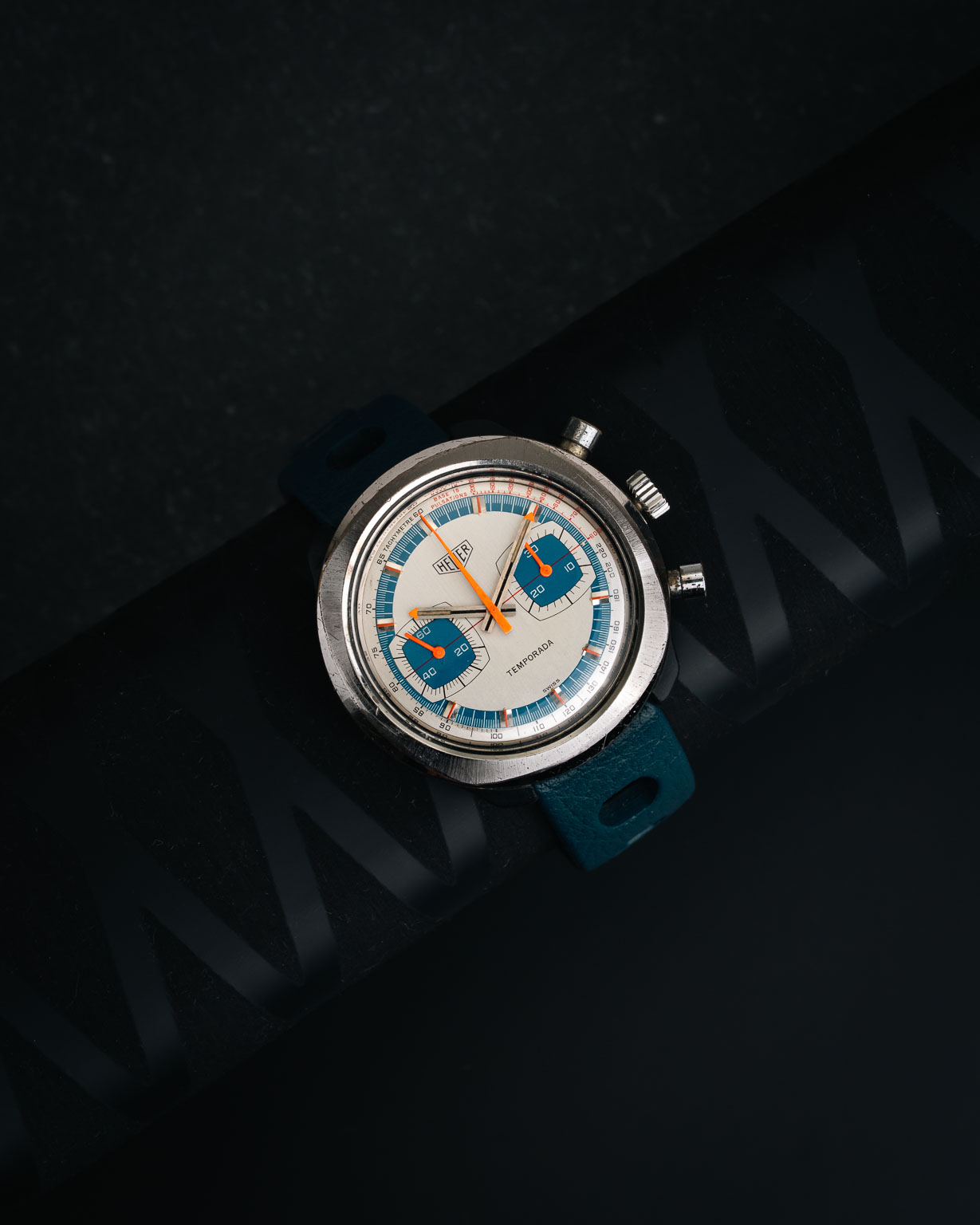
Despite its position within the catalogue, the watch possesses a personality entirely its own. Bright colours, contrasting minute tracks, distinctive hands and an unconventional dial layout gave the Temporada an appearance unlike anything else Heuer was producing at the time.
It never tried to imitate the Carrera.
It never tried to resemble the Autavia.
And it certainly never attempted to become another Monaco.
Instead, the Temporada embraced a more youthful, optimistic design language that reflected the changing aesthetics of the early 1970s.
Today those design choices feel refreshingly confident rather than merely fashionable.
The forgotten branch of the Heuer family
The Temporada also reminds us that Heuer’s history cannot be reduced to racing chronographs alone.
During this period the company was experimenting across multiple directions simultaneously. Models such as the Easy-Rider and the Temporada demonstrate a willingness to explore new construction methods and different market segments while the legendary chronographs continued to define Heuer’s public image.
That broader perspective makes the brand’s history considerably richer.
The Temporada was never intended to compete directly with the Carrera or Monaco. It existed alongside them, solving a different commercial challenge while quietly demonstrating that innovation sometimes emerges from practical necessity rather than ambitious engineering.
Why collectors are rediscovering the Temporada
Vintage collecting has changed.
For many years, enthusiasts understandably focused on the most famous references. Increasingly, however, collectors are looking beyond the obvious icons in search of watches that tell a less familiar story.
The Temporada belongs firmly in that category.
It represents an important moment in Heuer’s development, illustrating how the company responded to changing market conditions without abandoning its willingness to experiment. The very characteristics once introduced to create a more accessible chronograph are now among the reasons collectors find the model so appealing.
Its originality was not manufactured through exclusivity.
It was earned through circumstance.
About this watch
The example presented here perfectly illustrates why the Temporada has become such an intriguing collector’s watch.
Its distinctive fibreglass monocoque case remains one of the most recognisable design features of the model, while the vibrant dial layout preserves the unmistakable character that separates the Temporada from every other Heuer chronograph of its era.
More importantly, this watch represents a chapter of Heuer’s history that is still unfamiliar to many collectors. Rather than following the well-trodden path of the Carrera, Autavia or Monaco, it offers an opportunity to appreciate a period in which the brand responded creatively to changing market conditions and produced one of its most unconventional designs.
For collectors who enjoy discovering the lesser-known stories behind great watchmakers, that individuality is perhaps the Temporada’s greatest attraction.
Closing thoughts
History often celebrates the watches that changed an industry.
Less attention is given to the watches that helped a company survive long enough to keep innovating.
The Heuer Temporada belongs to that second group.
It was conceived as a practical response to a changing market, not as a future collector’s piece. Yet time has transformed its perceived compromises into strengths. The lightweight composite case, the unconventional construction and the bold design language now tell a story that feels remarkably modern.
Perhaps that is the Temporada’s greatest achievement.
It reminds us that the most interesting watches are not always those created with the grandest ambitions.
Sometimes they are the ones that solved yesterday’s problems so intelligently that they still feel relevant half a century later.

