


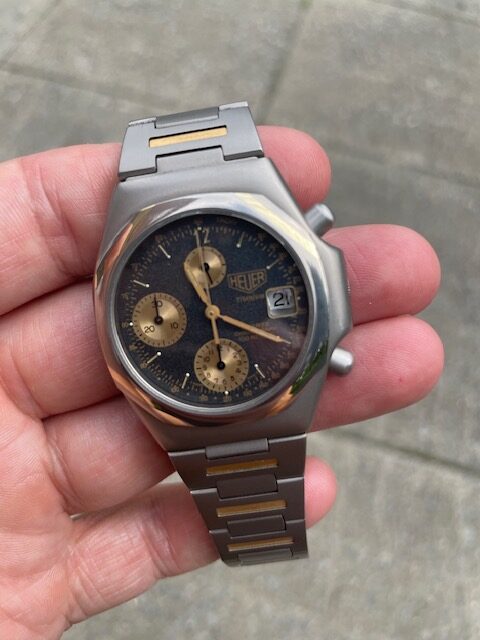

“The Heuer that looked toward the future, not the past”
Heuer’s best-known vintage chronographs date from the 1960s and 1970s. Names such as Carrera, Autavia and Monaco have since become inextricably linked with the brand. The Heuer Titanium Chronograph 225.206 comes from an entirely different era. This watch appeared in the early 1980s, when the watch industry was changing dramatically and Heuer was searching for a new interpretation of the luxury sports watch.
The result was not an attempt to recreate past successes. Heuer opted for titanium, sapphire crystal, quartz precision and a striking combination of grey and gold. Beneath the dial was also a movement that united electronics with traditional chronograph technology.
This is precisely what makes the 225.206 one of the most interesting Heuer watches from this transitional period. Its design is unmistakably from the 1980s, yet at the same time it carries with it much of Heuer’s technical heritage.
A Different Kind of Vintage Heuer
At the beginning of the 1980s, the Swiss watch industry was still dealing with the consequences of the quartz revolution. Electronic watches were accurate, affordable and increasingly widely available. This caused serious difficulties for many traditional manufacturers. Heuer, too, had to reinvent itself.
The company did have one advantage. Electronics were not entirely unfamiliar territory for Heuer. Alongside wristwatches, the brand had been producing professional timing equipment for sports and motor racing for many years. During its collaboration with Ferrari, which began in 1971, Heuer supplied electronic systems capable of simultaneously tracking multiple racing cars and automatically processing lap times.
This technical background explains why Heuer did not see quartz solely as a threat. Electronic precision could also become part of a new generation of watches. The Titanium Collection was one of the most ambitious examples of this approach.
The Titanium Collection: Watches for the Future
Heuer introduced the Titanium Collection in 1983. In the documentation of the time, titanium was presented as the material of the future. Images of the Space Shuttle emphasised the collection’s modern character. From today’s perspective, that may sound somewhat theatrical, but in the early 1980s, the use of titanium in a luxury wristwatch was genuinely exceptional.
The material combines high strength with relatively low weight and good resistance to corrosion. Untreated titanium also has a dark, warm grey tone that is clearly different from the brighter appearance of stainless steel. As a result, a titanium watch not only feels lighter on the wrist but also has a distinctly different appearance.
The collection consisted of various watches for men and women, including quartz watches, automatic models and chronographs. The different versions featured accents in gold or a black material that was associated with carbon fibre in the documentation. Heuer chose sapphire crystal for the watches, which at the time was considerably more expensive and less commonly used than the mineral glass found on many other Heuer models.
The Titanium Collection was therefore not intended as an affordable quartz series. On the contrary, it was one of the most luxurious and modern lines in the catalogue.
The Distinctive Design of the 225.206
Within this collection, the 225.206 was among the most expensive models. The case and bracelet are made of titanium, while the bezel and various details of the watch have a gold-coloured finish. The same contrast is repeated on the dial.
The anthracite-grey base provides a calm background for the three gold-coloured registers. The hands, hour markers and outer tachymeter scale also complement this colour scheme. The design is therefore striking yet remains well balanced. The gold-coloured elements have not been added at random; visually, they extend from the case to the dial and the matching titanium bracelet.
The round case measures approximately 38 millimetres. For a watch from this period, this is a generous yet still comfortably wearable size. Thanks to the low weight of titanium, the 225.206 also feels lighter than its substantial case and solid bracelet might suggest.
Although the bracelet attachment is strongly incorporated into the design of the case, it is not technically a fully integrated bracelet. Heuer designed the watch so that the original titanium bracelet could, if desired, be replaced with a conventional leather watch strap. The original bracelet with its matching gold-coloured inserts, however, forms an important part of the design and is particularly valuable when found on a complete example.
The original price also shows that the 225.206 was positioned as an exclusive watch. In 1984, this version cost 1,800 dollars in the United States. By comparison, many traditional mechanical Heuer chronographs were listed at prices ranging from approximately 195 to 595 dollars at the time. The titanium and gold chronograph was therefore not an inexpensive quartz alternative, but one of the brand’s flagship models.
Calibre 185: Quartz Precision with a Mechanical Chronograph
The dial of the 225.206 simply reads “Quartz”. While this indicates how the regular time display is regulated, it does not reveal just how unusual the complete movement is.
Heuer used Calibre 185 for this model. This modular calibre consists of an ESA 555.232 quartz base movement combined with a mechanical chronograph module by Dubois-Dépraz. The hours, minutes and regular seconds are therefore regulated electronically. The stopwatch function, however, operates using mechanical components.
When one of the chronograph pushers is pressed, a system of levers, wheels and couplings is set in motion. Starting, stopping and resetting therefore take place in a manner much closer to a traditional mechanical chronograph than to a fully electronic quartz chronograph.
This construction gave Heuer the best of both worlds. The owner received the accuracy and convenience of quartz, while the chronograph remained an independent mechanical mechanism. It suited a brand that had built its reputation on stopwatches and chronographs, yet did not want to remain tied to the technology of the past.
Calibre 185 therefore makes the 225.206 more interesting than the word “Quartz” might initially suggest. The movement is a tangible example of how Swiss manufacturers experimented with electronics during the 1980s without completely abandoning their mechanical expertise.
A Titanium Sibling to the Fittipaldi Edition
Within the Titanium Collection, one name comes up often among collectors: Fittipaldi. In 1985, Heuer released a special edition carrying the name of Brazilian racing driver Emerson Fittipaldi, Formula One World Champion in 1972 and 1974, who was then building a new career in the American IndyCar series.
That special edition was built on reference 223.206, the carbon-fibre-accented sibling of the 225.206, with “Fittipaldi” printed directly on the dial. The 225.206 offered here, with its gold accents, is a different reference within the same Titanium chronograph line, and it does not carry the Fittipaldi name or signature.
The two watches nonetheless belong to the same short chapter of Heuer’s history: the same case architecture, the same Calibre 185 movement, and the same era in which Heuer used its motorsport connections, titanium construction and modern materials to signal where the brand was heading next. Seen in that light, the 225.206 is best understood as the more luxurious, gold-accented counterpart to the watch that carried Fittipaldi’s name, rather than as a Fittipaldi model in its own right.
One of the Last Watches to Feature the Classic Heuer Logo
The name on the dial also makes this chronograph particularly interesting. The watch bears only the classic Heuer shield and not the later TAG Heuer logo.
The Heuer family had already sold the company in 1982 to a group that included Piaget and Nouvelle Lemania. In 1985, Heuer was subsequently acquired by Techniques d’Avant Garde. From 1986 onwards, the watches were released under the TAG Heuer name.
The 225.206 comes from precisely the period between these events. It is one of the last models to bear only the Heuer name, yet technically and stylistically it already points towards the later TAG Heuer. Materials such as titanium, quartz technology, sporty construction and the enduring connection with motor racing would continue to be important elements of the brand in the years that followed.
Why the Heuer 225.206 Is Worth Collecting
The Heuer Titanium Chronograph 225.206 does not fit the conventional image of a vintage Heuer. It does not have a mechanical chronograph calibre from the 1960s, a classic panda dial or the restrained design of an early Carrera. That, however, makes it no less interesting.
This watch shows how Heuer responded to one of the most difficult periods in the history of the Swiss watch industry. The brand selected a material that was still considered futuristic at the time, combined it with sapphire crystal and an expensively produced bracelet, and used a hybrid calibre in which quartz and mechanical technology work together.
The 225.206 was also produced for only a relatively short period. Examples that retain their original titanium bracelet are more difficult to find than standalone watches or watches fitted with a later replacement strap.
The combination of titanium, gold-coloured accents, Calibre 185 and the classic Heuer logo gives this watch a unique place within the history of the brand. It is not a nostalgic look back at Heuer’s glory days, but a watch that demonstrates how the company envisioned its future. It also sits directly alongside one of the more colourful footnotes in that story: the moment a Formula One and IndyCar champion lent his name to Heuer’s most futuristic-looking collection.
And that is precisely where the appeal of the 225.206 lies: this is not a conventional vintage chronograph, but a rare survivor from a period in which Heuer was redefining what a modern sports watch could be.

