



Omega Seamaster 120: when the 120 grew up
The Seamaster 120 began as the smaller, more restrained alternative in Omega’s diving family. Reference 166.088 shows what happened when that idea entered the 1970s.
The name sounds familiar. The watch does not.
When Omega introduced the Seamaster 120 in the 1960s, it was a relatively compact diving watch: purposeful, clean and considerably less imposing than the Seamaster 300. Only a few years later, reference 166.088 carried the same Seamaster 120 name into a completely different design language. The case became broader, the bezel more substantial and the entire watch acquired the confidence that would define so many sports watches of the early 1970s.
It is tempting to describe that simply as an increase in size. But that misses the more interesting point. The Seamaster 120 had not merely become bigger. It had grown into a different kind of watch.
Before the Seamaster became a dive-watch name
The Seamaster story began in 1948, long before the name became almost inseparable from rotating bezels and underwater watches. The original idea was broader: a robust, water-resistant wristwatch intended to cope with ordinary life while remaining elegant enough to wear every day.
That changed considerably in 1957. Omega introduced the Seamaster 300 alongside the Speedmaster and Railmaster, giving each watch a more clearly defined purpose. The Seamaster 300 became the diving member of that trio and helped establish a new, more professional side of the Seamaster family.
The Seamaster 120 followed in 1966 and offered a different interpretation of the diving watch. The early models were more compact and less visually imposing than the Seamaster 300. They combined genuine sporting intent with dimensions that remained close to those of a conventional wristwatch.
That difference is important because it explains what happened next. The Seamaster 120 was never simply one fixed design. It was an idea Omega could continue to develop.
The moment the 120 changed character
By the beginning of the 1970s, Omega was designing watches for a very different visual world.
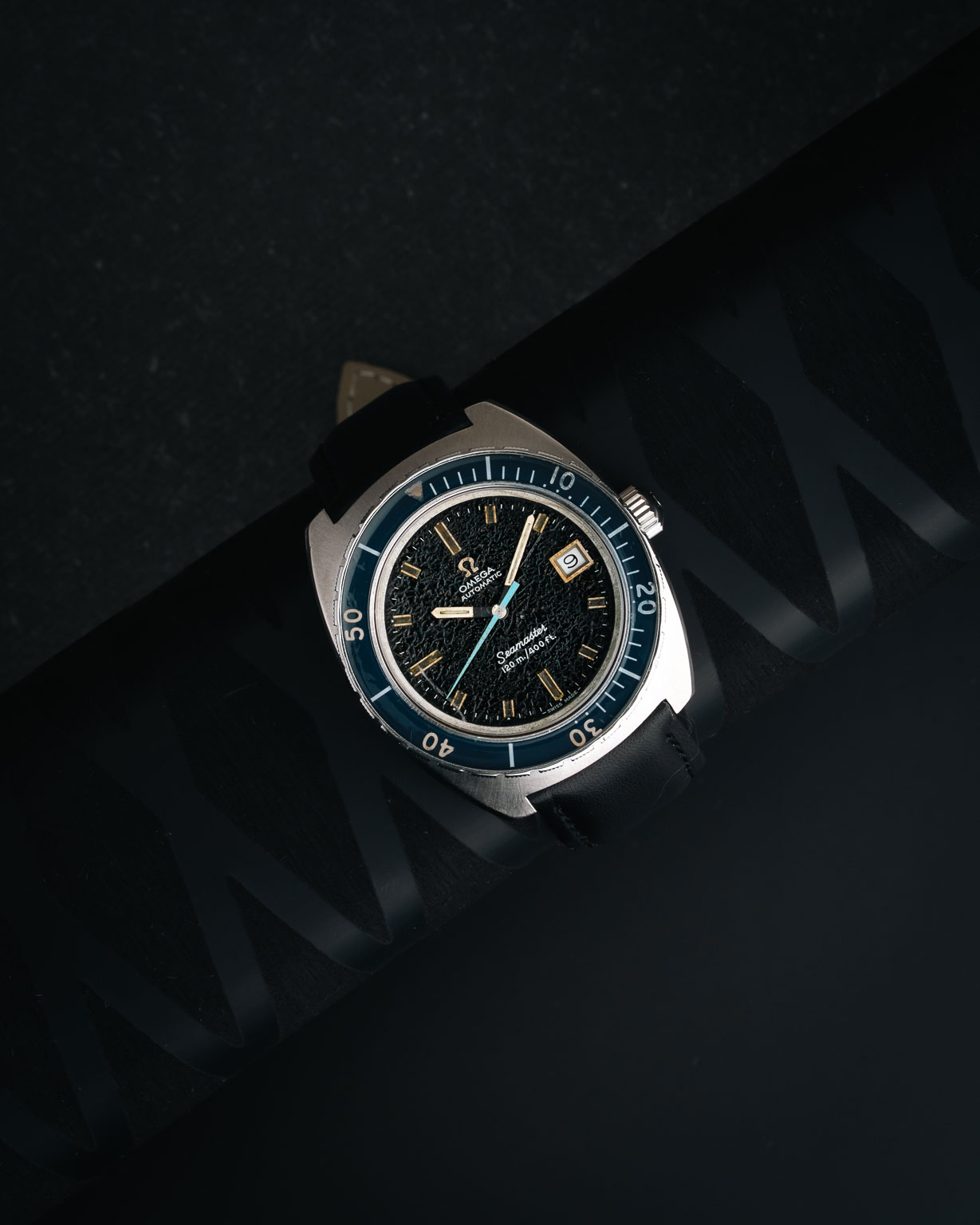
Reference 166.088 makes that change immediately visible. Its stainless-steel case measures approximately 39 mm across, but the increase in diameter tells only part of the story. The short lugs, broad case body and prominent rotating bezel make the watch appear considerably more substantial than the earlier Seamaster 120.
There is very little delicacy in the architecture, and that is part of its appeal. The watch has the deliberate geometry that became increasingly visible at the end of the 1960s and into the following decade. The case no longer tries to disguise the fact that this is a sports watch.
At the same time, the proportions remain remarkably controlled. Around 39 mm is still completely natural on a modern wrist, while the short lug structure keeps the watch compact. This is one of the reasons the 166.088 can feel more contemporary than many watches produced only a few years earlier.
The Seamaster 120 had crossed a design boundary. One generation belonged unmistakably to the 1960s. This one was already looking forward.
A dive watch that discovered colour
The case establishes the period, but the dial gives the 166.088 its personality.
At first glance, the ingredients are conventional enough for a diving watch. There is a dark dial, highly visible hands, a date window at three o’clock and a rotating timing bezel. The applied hour markers add depth, while the strong contrast between the hands and dial keeps the basic information easy to read.
Then Omega added blue.
The blue central seconds hand is a relatively small detail, but it changes the character of the entire watch. Against the dark dial, it provides a flash of colour without interfering with legibility. Together with the blue-toned bezel associated with the reference, it gives the Seamaster 120 a personality quite different from the stricter black-and-white appearance of many traditional diving watches.
It is one of those details that becomes more important the longer you look at the watch. Remove it and the design immediately becomes more conventional.
That willingness to use colour is significant. The 166.088 remains recognisably a functional diving watch, but it also shows Omega becoming more adventurous with proportion, surface and colour as the 1970s began.
Calibre 1002 and another Omega transition
The change was not limited to the outside.
Inside the ref. 166.088 is Omega’s automatic calibre 1002, providing central seconds and a date display at three o’clock. Running at 28,800 vibrations per hour, it belonged to a newer generation of higher-frequency automatic movements as Omega moved beyond the architecture of its earlier automatic calibres.
This makes the movement particularly appropriate for the 166.088. The exterior of the watch was changing, but so was the engineering inside it. The reference therefore represents more than a stylistic transition between decades. It belongs to a period in which Omega was reconsidering both the appearance and construction of its watches.
Calibre 1002 does not enjoy quite the same romantic reputation among collectors as some of Omega’s earlier movements, and there is little reason to pretend otherwise. Its interest here lies in the period it represents. It is part of the mechanical story of Omega entering the 1970s, just as the case and dial are part of the visual story.
The details that make a 166.088
Vintage watches are often identified by a reference number and then treated as though every surviving example were essentially the same. With the Seamaster 120 ref. 166.088, that approach misses much of what matters.
The dark dial, applied markers, contrasting handset, blue central seconds hand and rotating bezel work together as a composition. Remove or incorrectly replace one of those elements and the balance changes surprisingly quickly.
This is particularly relevant because diving watches were built to be used. Bezels become worn, hands are replaced, cases are polished and dials can age in very different ways. None of those things can be judged properly from the reference number alone.
Age itself is not the problem. A faded bezel can look beautiful when it belongs naturally with the dial beneath it. Lume can develop warmth, while fine marks on a case may be far preferable to heavily polished surfaces that have lost their original geometry.
What matters is coherence. With the 166.088, character comes from the relationship between the parts rather than from one spectacular feature in isolation.
More than the smaller Seamaster
The Seamaster 120 is often introduced as the smaller relative of the Seamaster 300. That description is useful when discussing the earliest generation, but it becomes much less convincing when applied to ref. 166.088.
By this point, the 120 had developed a visual identity of its own.
Its case did not simply imitate the Seamaster 300. Its handset was different. Its use of colour was different. Even the way it sat on the wrist had changed. The watch had become a separate branch of Omega’s diving-watch family rather than merely a reduced alternative to something more professional.
That is perhaps the best way to understand the reference today. The 166.088 is not interesting because it resembles one of Omega’s more famous watches.
It is interesting because it does not.
About this watch
The ChronoMasters example is an Omega Seamaster 120 ref. 166.088 powered by the automatic calibre 1002. Its dark dial, applied hour markers, contrasting hour and minute hands, date at three o’clock and distinctive blue central seconds hand give it the characteristic appearance associated with this later generation of Seamaster 120.
Those details are particularly important on this model because the appeal of the 166.088 depends heavily on its overall balance. The substantial case, rotating bezel and unusual handset need to work together; no single element tells the complete story.
As with any vintage watch, originality should be considered component by component rather than assumed from the overall appearance. Dial, hands, lume, bezel, crown, crystal, case, bracelet and movement each contribute to the integrity of the watch.
What can immediately be appreciated is the character of the design itself. More than half a century after it appeared, the 166.088 still looks unusual enough to be immediately recognisable, yet its proportions make it remarkably easy to wear today.
Closing thoughts
The easiest way to understand the Omega Seamaster 120 ref. 166.088 is to place it beside one of the earlier Seamaster 120s.
The name survived. Almost everything else moved on.
In only a few years, Omega took a compact 1960s diving watch and turned it into something broader, more architectural and more colourful. Even the movement belonged to a newer generation. The transformation is complete enough that the two watches can initially appear to come from different families.
That is precisely what makes the 166.088 worth remembering.
It captures a moment when Omega was not merely updating the Seamaster 120 but redefining what it could be. The earlier watch belonged to the restrained proportions of the 1960s. Reference 166.088 arrived at the threshold of a decade that preferred stronger shapes, greater presence and a little more colour.
The Seamaster 120 had kept its name.
It had simply grown up.
See the watch featured in this story
The Omega Seamaster 120 ref. 166.088 featured in this article is currently available at ChronoMasters. View the watch, its condition, photographs and full product details.
View this Omega Seamaster 120
